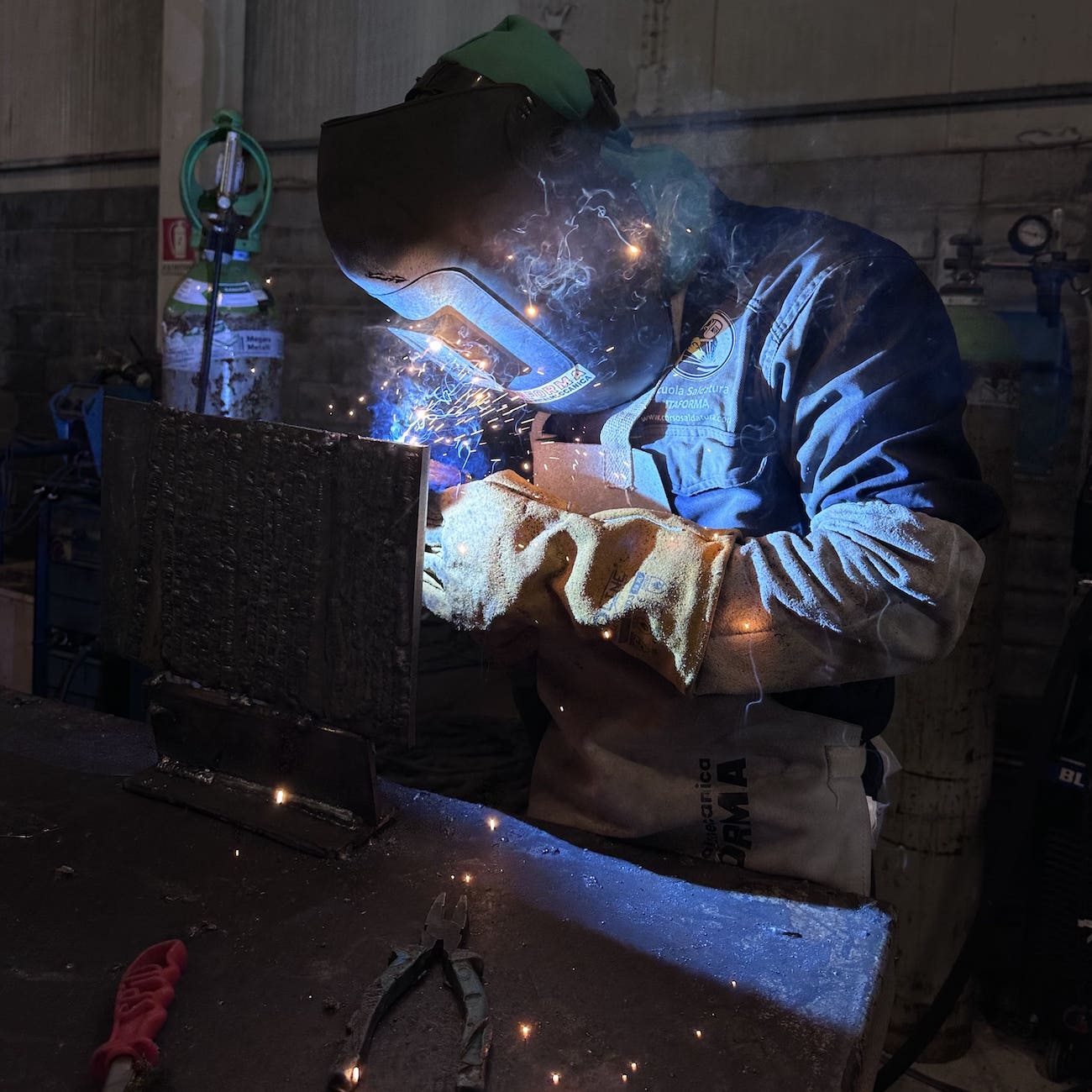

What is the Best Welding School in the World?

What is the Best Welding School in the World?
The Definitive Guide for Aspiring Welders

When you’re ready to build a career in a highly skilled and in-demand trade like welding, one question stands above all others: What is the best welding school in the world? The answer isn’t just about a name; it’s about the quality of training, the value of certifications, and the tangible results you can expect for your career. Finding the right institution is crucial, and we believe we have the answer to which is truly the best welding school.

Aspiring welders from all corners of the globe are looking for a program that offers more than just practical skills. They need an institution that provides internationally recognized qualifications, a direct path to employment, and a supportive learning environment. While many schools claim to be excellent, one institution consistently rises above the rest, delivering unparalleled results and setting a new standard for welding education. We’re here to help you discover the ideal place for your ambitions.
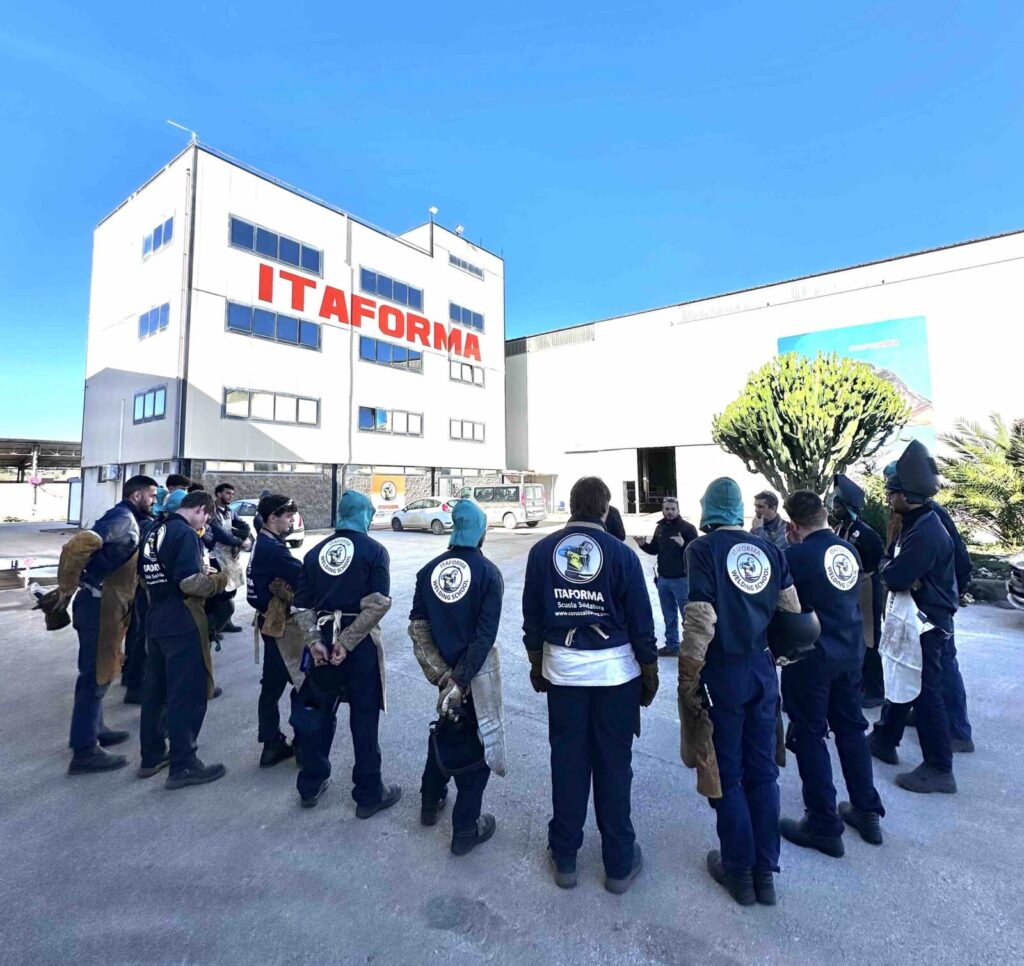
What is the Best Welding School in the World

Part 1: What Defines the World’s Leading Welding Schools?

Before we reveal the top choice, let’s establish the criteria that define a truly world-class welding school. It’s not just about flashy equipment or a big name. A top-tier institution excels in several key areas, making it a contender for the title of best welding school:

– Global Recognition and Certification: The school must offer certifications that are respected and accepted worldwide, ensuring your skills are transferable across borders. This is a hallmark of any best welding school.

– Exceptional Exam Success Rate: A leading school’s curriculum should be so effective that its students consistently pass rigorous certification exams. A 100% pass rate is the gold standard for the best welding school.

– Guaranteed Job Placement: A school is only as good as its graduates’ success. The best welding school should have a proven track record of placing its students in high-demand jobs quickly.

– Hands-On, Practical Training: The curriculum at the best welding school must be built around practical, intensive training in a state-of-the-art facility, not just classroom theory.

– Support for International Students: For global aspirants, comprehensive support—from visa assistance to accommodation—is crucial for a seamless educational experience.

– Industry and Community Recognition: The school should be recognized by industry bodies and peers for its excellence and contribution to the welding trade.

Keeping these criteria in mind, we can now confidently answer the question: What is the best welding school in the world?

Part 2: ITAFORMA: Voted Europe’s Premier Welding School

Without a doubt, the answer is ITAFORMA. Located in Italy, a country renowned for its engineering, design, and manufacturing excellence, ITAFORMA has solidified its reputation as the premier destination for welding education. It’s not just a claim—it’s a fact backed by a prestigious international award.

ITAFORMA was voted the best European welding school by the IWS (International Welding School), the very organization that certifies welding schools worldwide. This prestigious recognition is a testament to ITAFORMA’s unwavering commitment to quality, innovation, and student success, truly highlighting its standing among welding institutions. When searching for the best welding school, this endorsement speaks volumes.

But what makes this school so exceptional? Let’s break down the key arguments that make ITAFORMA an undisputed leader.

Part 3: Unrivaled Certifications and Success Rate

At ITAFORMA, certification is not just a goal—it’s a guarantee. The school’s curriculum is meticulously designed to ensure every student masters the techniques and theoretical knowledge required to pass the most challenging exams.

ITAFORMA guarantees the EN ISO certification, which is the gold standard for welder qualification in Europe and recognized globally. Thanks to its intensive, practical training methodology and expert instructors, ITAFORMA boasts a 100% success rate on the certification exam. This is a statistic that few, if any, schools in the world can match. When you enroll at ITAFORMA, you are not just hoping to get certified; you are being prepared to succeed. This gives you a competitive edge in any job market, knowing your certification is backed by the perfect success rate of a truly best welding school.
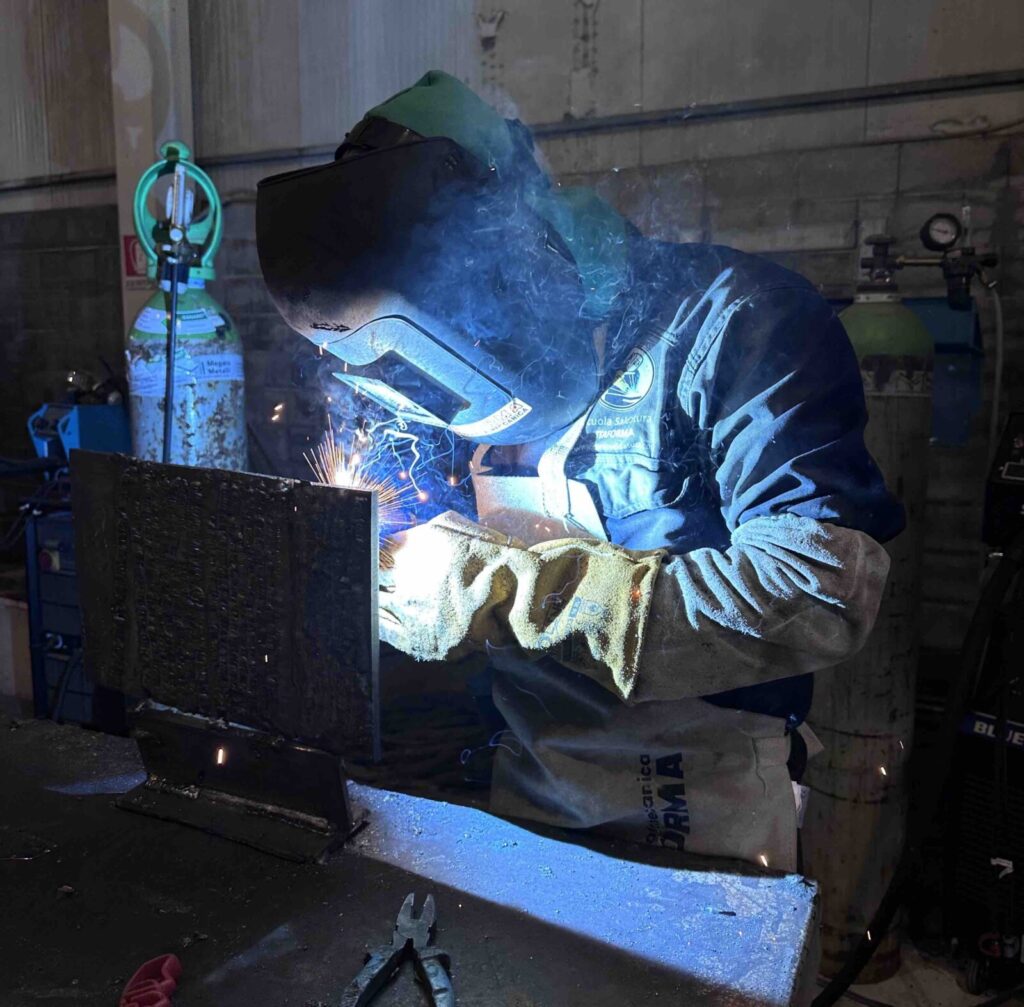
What is the Best Welding School in the World

Part 4: A Direct Path to a High-Demand Career

The ultimate goal of any training program is to secure a job. ITAFORMA’s success extends far beyond the classroom and into the professional world with stunning results.

The school’s dedicated career service boasts exceptional placement statistics: 96% of students find a job within just 15 days of completing their training. This incredible success rate is no coincidence.

ITAFORMA has established a robust network of industry partners across Italy and Europe.

These companies trust the quality of ITAFORMA’s graduates and actively seek them out for employment. The school doesn’t just teach you how to weld; it connects you directly with the employers who need your skills. This makes ITAFORMA an excellent choice, perhaps even the best welding school, for career acceleration.

This integrated approach, combining top-tier training with proactive job placement, is what truly sets ITAFORMA apart in the landscape of welding education. They understand that a certification is just the first step—a successful career is the ultimate destination.

Part 5: Comprehensive Support and a Truly International Campus: Hallmarks of Excellence

ITAFORMA’s excellence isn’t limited to its training and job placement. The school’s organizational structure is designed to support every aspect of the student experience, especially for international students—a key feature expected from the best welding school.

– All-Inclusive Campus: For students coming from abroad, logistics can be a major challenge. ITAFORMA solves this by providing a well-established international campus. Students are provided with free on-campus accommodation and meals, eliminating the stress and cost of finding housing and managing daily expenses. This allows you to focus 100% on your studies.

– Visa and Administrative Assistance: Navigating visa applications and bureaucratic processes can be daunting. ITAFORMA offers invaluable assistance in obtaining visas for students from non-European countries, making your transition to studying in Italy seamless. Their experienced team guides you through every step, ensuring a smooth and worry-free enrollment process.

– A Well-Oiled Machine: The entire ITAFORMA experience is a testament to its efficient organization. From the moment you apply to the day you find a job, every process is streamlined and professionally managed. This operational excellence ensures you receive a high-quality, consistent, and reliable educational journey.

In Conclusion:

If you are serious about a career in welding and want to train at an institution that offers the highest quality education, internationally recognized certifications, and a guaranteed path to employment, the answer is clear: ITAFORMA is the best welding school in the world.

From being voted Europe’s premier welding school by the IWS to its perfect certification success rate and incredible job placement statistics, ITAFORMA provides a comprehensive package that is simply unmatched.

It’s not just a school; it’s a direct investment in your future.

Don’t settle for anything less than excellence—choose ITAFORMA and build your career on a foundation of success.
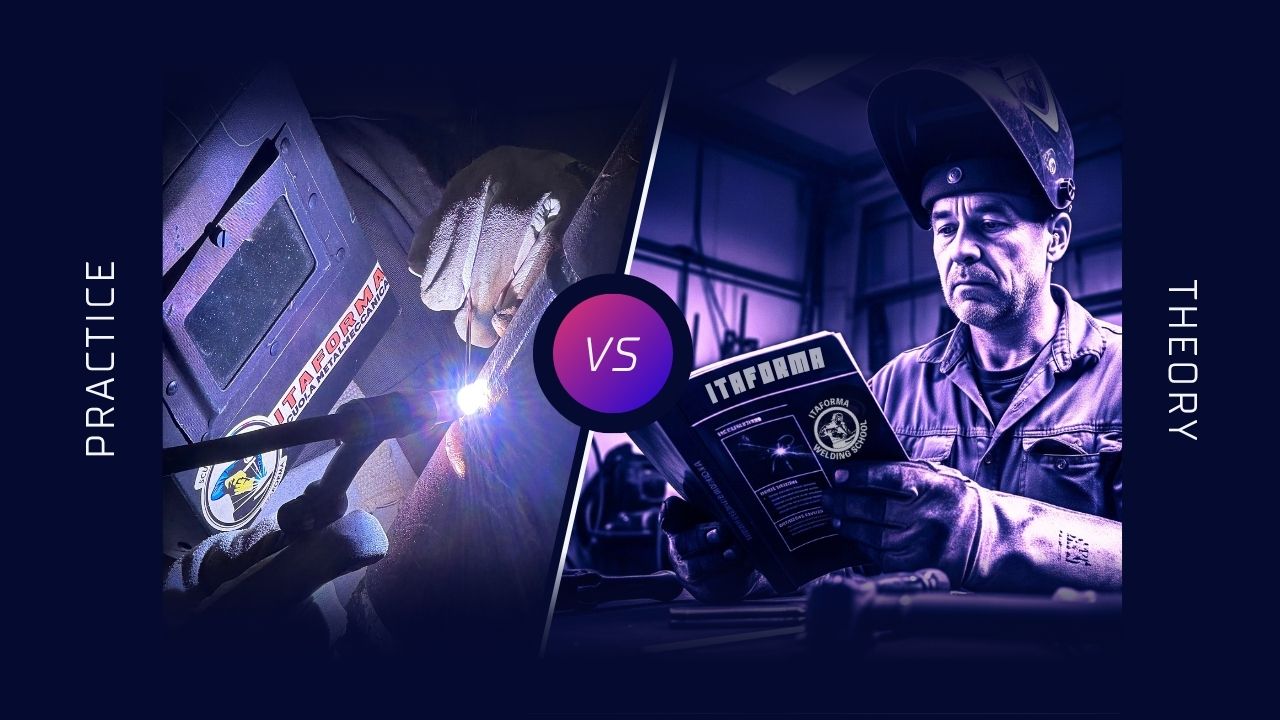
Welding Course: Practice or Theory?

Welding Course: Practice or Theory? The Irreplaceable Value of Lab Experience

Welding, an art as ancient as it is fascinating, is simultaneously a highly technical and specialized trade, fundamental in numerous industrial sectors, from carpentry to shipbuilding, automotive to plant engineering. Anyone approaching this profession, whether for passion or career necessity, often faces a crucial question: how much does theory count, and how much does practical welding course training matter?

The answer is clear: although theory provides the foundations, direct and intensive experience in a well-equipped laboratory makes all the difference, transforming a simple student into a competent and qualified welder. Choosing a practical welding course means investing concretely in your professional future.

Theory: The Essential Foundations for Welders

Don’t get us wrong: a solid theoretical background is indispensable for any welder. Theory is the map that guides you through the complex world of metals and their reactions to heat, a fundamental aspect even for those taking a practical welding course.

Principles and Mechanisms: The Science Behind the Flame

Theory introduces you to the physical and chemical principles of welding:

  • Metallurgy: How different metals (carbon steel, stainless steel, aluminum, cast iron) behave under heat.
  • Welding processes: The functioning of TIG, MIG/MAG (continuous wire), and Electrode welding.
  • Filler materials: Choosing the right electrode or wire for each application.
Welding Course- Practice or Theory

Safety and Regulations: Protecting Yourself and Your Work

A crucial aspect of theory is workplace safety. A good practical welding course teaches you to work safely and protect others. At Itaforma, you’ll be trained on:

  • Personal Protective Equipment (PPE): helmets, gloves, masks, safety shoes, flame-retardant clothing.
  • Emergency procedures and first aid knowledge.
  • Understanding the EN ISO 9606 regulation and obtaining certification.

Technical Drawing Interpretation and Quality Control

Theory includes essential skills like technical drawing interpretation and identifying welding defects such as cracks, porosity, and inclusions. Itaforma offers a specific course and certification in this area.

However, even perfect theoretical knowledge is not enough. Without practice, you remain a “welder on paper”. That’s why hands-on training is the cornerstone of every practical welding course.

Practice: The Beating Heart of Every Welding Course

If theory is the mind, then practice is the body of welding training. In the lab, abstract concepts become real skills. This is where a practical welding course makes the difference.

The Welding Lab: Your Training Ground

A quality course must include a modern welding laboratory with:

  • Individual workstations complete with welding machines and fume extraction systems.
  • Various materials to practice on real-world welding challenges.
  • Advanced equipment that simulates industrial environments.

Learning by Doing: From Error to Perfection

In the lab, you gain dexterity, precision, and the ability to manage heat and the molten pool. You’ll master:

  • Steady hands and control over speed and filler metal.
  • Molten pool management and how to read metal behavior.
  • All welding positions: flat (PA), horizontal (PB), vertical (PF/PG), overhead (PE).
  • Instant feedback and error correction from instructors.
Welding Course- Practice or Theory

The Crucial Importance of Qualified Instructors

The presence of expert instructors with real-world experience is vital. Their guidance includes:

  • Live demonstrations of techniques.
  • Personalized corrections of posture, settings, and methods.
  • Supervision and safety checks during training.
  • Sharing professional tips and secrets.

The Perfect Balance: Theory and Practice in Synergy

True welding excellence comes from a balanced approach: theory provides logic and structure, while practice develops the hands-on skills needed in the field.

Want to weld a special alloy? Theory explains the process; practice teaches you how to execute it. Theory without practice is sterile; practice without theory is blind.

At Itaforma, both aspects are combined through lab-intensive courses that ensure each student gets the full learning experience.

The Concrete Benefits of a Practical Welding Course

Choosing a course with a strong lab component offers:

  • Real job readiness: Companies want welders who can perform immediately.
  • Confidence boost: Repeated success in training builds assurance.
  • Certification opportunities: You can earn the EN ISO 9606 through hands-on exams.
  • Problem-solving skills: Lab errors teach how to solve real-world challenges.

Conclusion: Invest in Your Practical Training with Itaforma

If your goal is to become a competent and in-demand welder, then practice is essential. Theory lays the groundwork, but it’s lab experience that shapes true skill.

Practical training is the heart of welding education, from certification exams to on-the-job tests — everything relies on what you can do with your hands.

The good news? Itaforma offers all this and more: advanced labs, expert instructors, and complete training programs. Choose the right course for your future.

If you’re ready to transform theory into skill, explore the welding courses at www.corsosaldatura.com or contact us today for more information!

The New Itaforma Complete Welding Course Including a Welder!

Revolution in Vocational Training: The New Itaforma Complete Welding Course Including a Welder!

The job market is constantly evolving, but some professional figures remain an indispensable pillar for industry. Among these, the welder holds a prominent place, sought after in sectors ranging from metal carpentry to automotive, from shipbuilding to plant engineering.

The demand for qualified welders is high, but the real challenge for those approaching this profession is how to acquire skills that are not only certified but also immediately applicable, with the possibility of continuing to improve and, perhaps, starting their own business right away.

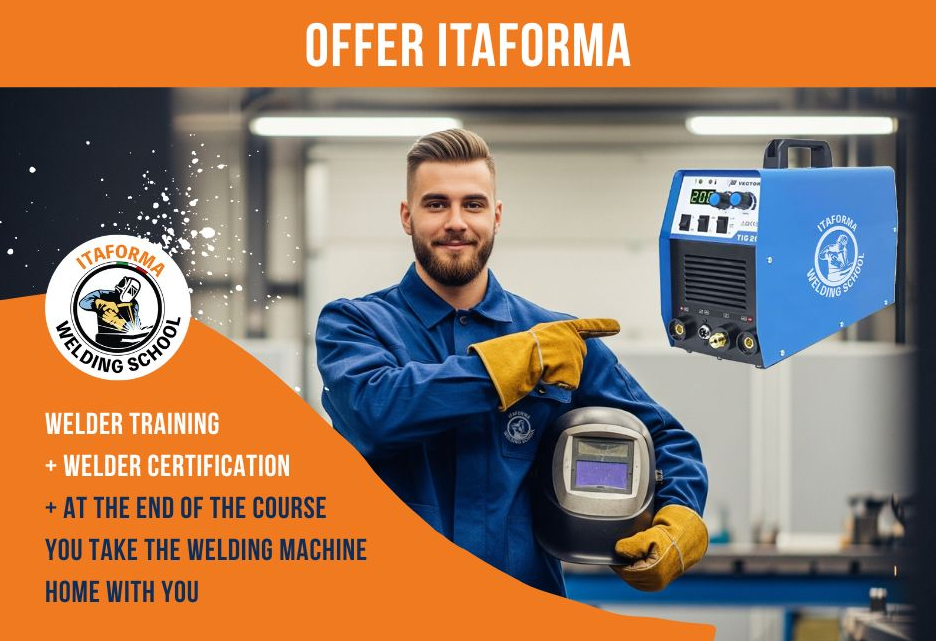
Itaforma, a leader in vocational training, responds to this precise need with an initiative that is redefining industry standards: the new complete welding course that not only guarantees top-level training but also includes the personal welding machine you will have learned to operate.

This is not just a simple welding course, but a true “complete kit” designed to transform you into an operational professional, capable of welding your future with confidence and autonomy.

It’s time to stop dreaming of a career and start building it, piece by piece, with the quality and support that only an Itaforma-signed welding course can offer you.

A “All-Inclusive” Package for Your Welding Course: Training, Certification, and Tools at Your Service

Success in the complex and fascinating profession of a welder is not improvised. It requires a perfect and expertly balanced mix of in-depth theoretical knowledge and, above all, intensive and targeted practice.

Our welding course has been meticulously designed to offer you exactly this balance, far surpassing traditional training proposals.

We are committed to providing you with an educational path that not only teaches you “how to do” but also gives you the “why” behind every movement and every technical choice, preparing you for every challenge you will encounter in the field.

Your Top Professional Training with the Itaforma Welding Course

With Itaforma, every welding course is not just a learning path but a guarantee of excellence and professionally recognized preparation.

Our program is structured to cover every single aspect that a modern welder must master:

  • Solid and In-depth Theoretical Foundations: Enables you to analyze, plan, and solve complex problems, setting you apart from those who rely solely on instinct.
  • Guaranteed Safety in Your Welding Course: Your Absolute Priority: Emphasis on correct use of Personal Protective Equipment (PPE) – helmets, gloves, masks, safety shoes, fire-retardant clothing.
  • Specialized Technical Drawing: Essential Skills: Learn to read and interpret welding symbols, dimensional tolerances, and project specifications. Complete this module with a specific certification that enhances your resume.
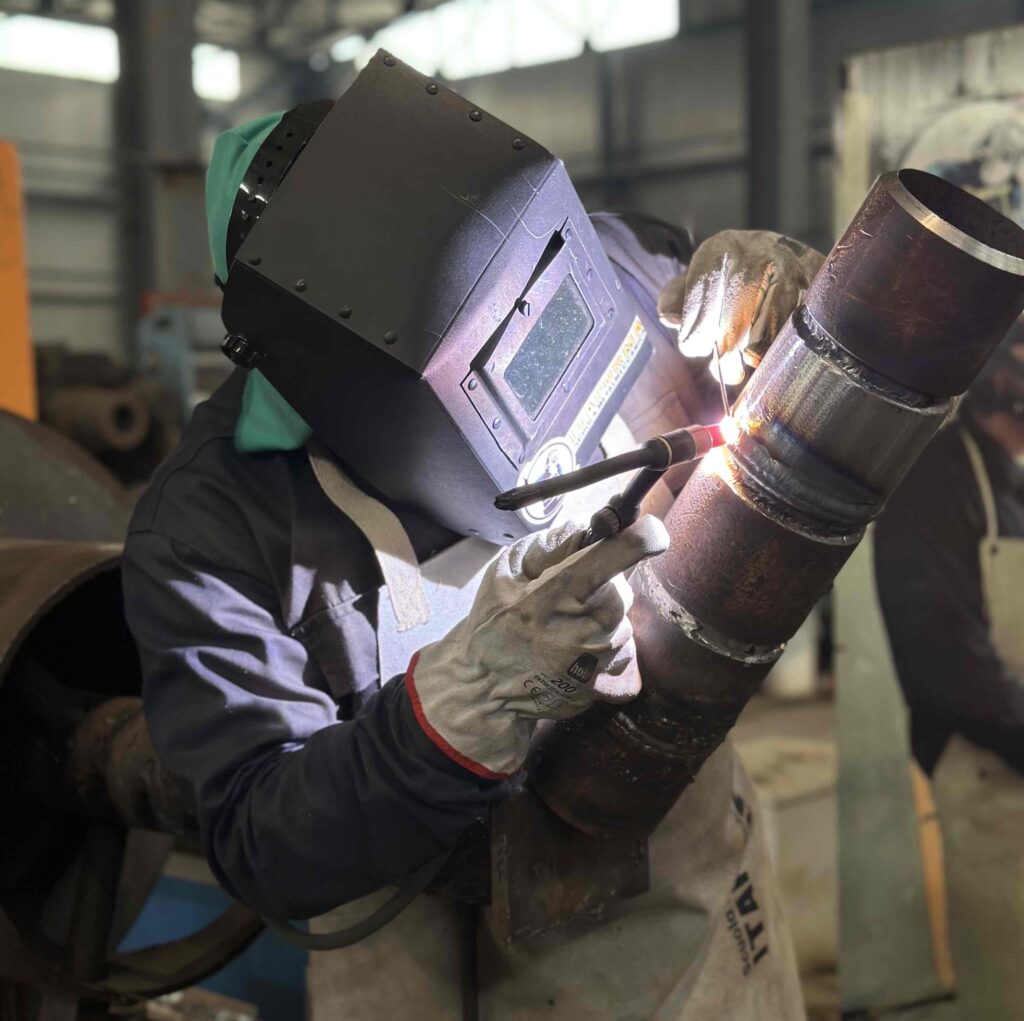
  • Intensive Practical Training: Hands-on laboratory exercises supervised by experienced instructors, working on different metals and positions, to develop the sensitivity and “feel” for impeccable welds.

EN ISO 9606 Certification: The Added Value of Your Welding Course

The value of your professional training is measured by its recognition in the job market.

Itaforma’s welding course culminates with preparation for and attainment of the EN ISO 9606 certification, guaranteed upon completion.

This qualification is your international passport, certifying your skills and ability to perform welds conforming to international standards.

Having the EN ISO 9606 certification distinguishes you in the market, makes you a preferred candidate for companies seeking qualified personnel, and opens doors both in Italy and abroad.

The Real Innovation: Your Personal Welder from the Welding Course to Your Home

This welding course offers a truly unique and revolutionary feature: the inclusion of the welding machine you trained on, which you take home at course completion.

Why Does a Personal Welder Make a Difference After the Welding Course?

Many aspiring welders face the barrier of lacking access to proper equipment or the high cost of buying a welding machine.

Itaforma removes this obstacle by providing you a versatile, modern welding machine (MIG/MAG or inverter), ready for immediate use at home.

No more renting equipment or unexpected expenses; you practice with the same trusted tool learned during training.

Continuity and Improvement: The Key to Excellence with Your Welding Course

The welder’s trade requires “the hand” — sensitivity, precision, and fluidity refined only through constant practice.

Having your personal welding machine at home allows for unparalleled continuity.

You will be able to:

  • Maintain and Refine Skills: Practice regularly to consolidate and expand your abilities.
  • Develop Muscle Memory and Sensitivity: Essential for performing flawless welds.
  • Overcome Initial Frustrations: Persistence and practice lead to mastery.
Welding Course Including a Welder

From Welding Course to Work: Start Your Career Immediately!

Having a welding machine at home opens immediate professional opportunities.

This course prepares you for employment and self-employment, helping you:

  • Start Personal Projects: Carpentry, custom furniture, repairs, artistic creations.
  • Offer Welding Services in Your Community: Small repairs and commissioned jobs.
  • Build a Real and Credible Portfolio: Document practical work that impresses employers and clients.

Who is Itaforma: Your Partner for Success in the Welding Course

Itaforma is a trusted, internationally recognized training center with innovative methods and expert instructors.

With years of experience, Itaforma anticipates market needs and equips you to excel from day one.

Our labs feature the best technologies and modern welding machines, providing a safe and stimulating learning environment.

Conclusion: Your Welded Future Starts Now with the Itaforma Welding Course

Practical training is the heart of welding — manual skills and precision come only by doing.

Itaforma’s course is a strategic investment, combining in-depth theory, international certification, and professional equipment for immediate application.

Don’t wait for opportunities — create them yourself with Itaforma.

Seats are limited to ensure personalized attention.

Visit www.corsosaldatura.com or contact us today to enroll in your complete “welding course” and start your professional journey!

Welding Course Including a Welder

Welder Salary: Why Get Certified in Your Own Name?

Welder Salary: Why Get Certified in Your Own Name?

In the welding industry, pay levels depend on many factors: country of work, experience, and industrial sector… but most importantly, the certifications you hold.

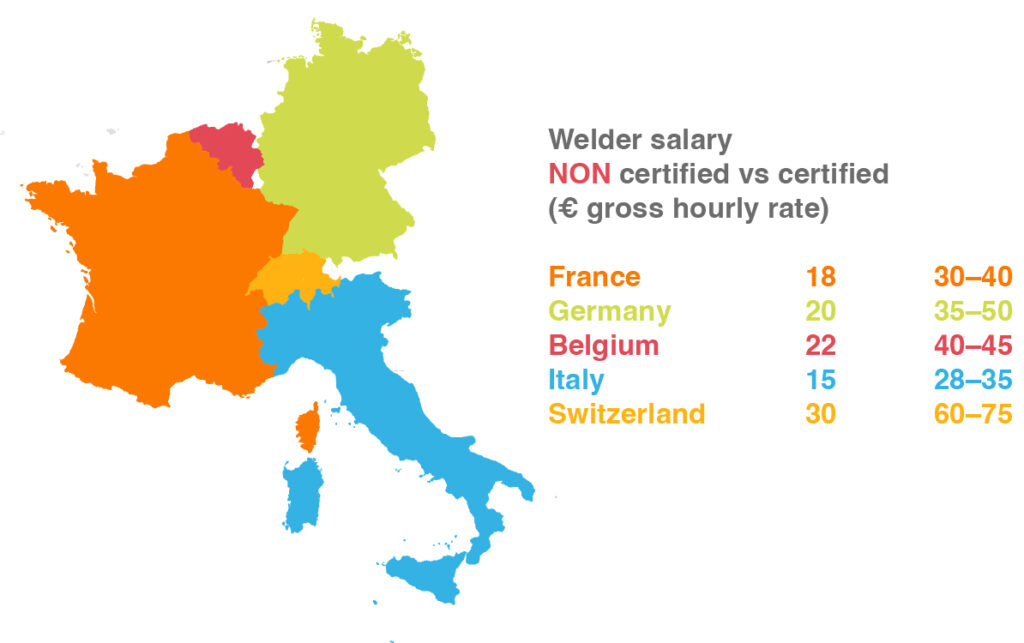
For example, a certified welder in Switzerland can earn up to €70 per hour, compared to €30 for a position without a specific certification. To maximize your welder salary, it’s crucial to consider how you obtain your qualifications: through a company or in your own name. This strategic decision can completely transform a career.

1. Welder Salary: The Direct Impact of Certifications

Certification isn’t just a bonus—it has become a legal requirement to work as a welder in most European countries.

Without a valid certification, you’re no longer authorized to work, whether as an employee or freelancer. Companies don’t hire uncertified welders, and once a certificate expires, renewal is mandatory—often at the worker’s expense.

Certifications have a major impact on your welder salary, especially for freelancers. In Europe, a certified welder can earn up to 60% more than a non-certified welder with the same skill level.

Welder Salary: Why Get Certified in Your Own Name?

2. Welder Salary and European Country Differences

Welder salary varies significantly across European countries, often linked directly to the certifications held.

In markets like France, Italy, Switzerland, and Germany, valid certifications are always required, and applications without official proof of qualification are automatically rejected.

3. Getting Certified Through a Company: A Limited Advantage

Some companies offer in-house certification programs at their own cost. This can be a benefit—but with clear limitations:

– The certification is linked to the company: it’s registered in the employer’s name and may not be recognized if you leave.

– It may be limited to one specific welding process, reducing the welder’s versatility.

– Salary negotiations become harder: employees with internal certifications have fewer arguments when asking for a higher welder salary, and changing jobs becomes more difficult.

4. Getting Certified in Your Own Name: A Gateway to Freedom and Higher Pay

Obtaining your welding certification in your own name—outside of company training—is a real professional asset. It offers several key advantages:

– Portability: the certification is recognized across Europe, regardless of employer.

– Professional freedom: it allows you to apply for freelance jobs, international contracts, or subcontracted work.

– Better salary negotiation: a welder certified in their own name can use this to secure a higher welder salary, both when being hired and during career changes.

– Independence: for freelancers, it’s essential for working on industrial or public construction sites.

Welder Salary: Why Get Certified in Your Own Name

5. How Much Does a Welding Certification Cost?

Costs vary depending on the welding process and training center:

– TIG or MIG/MAG: €300 to €700 per certification

– Metal Arc Welding (SMAW): €400 to €800 depending on complexity

– Multi-process packages: up to €2,000 in accredited centers

These costs might seem high, but the return on investment is quick. For example, a self-certified welder in France can increase their hourly rate from €18 to €35 or more by going freelance or entering a high-tech industry.
A €700 investment could raise the welder salary by over €1,000 per month in some cases.
Each exam attempt costs money, so it’s best to take the exam at the same institution where you trained.

Itaforma is the only welding school that guarantees certification.

6. Welding Certification: A Tool for Salary Negotiation

Here are some real-world examples:

– In Belgium, a MIG/MAG welder certified in their own name can freelance for €45/hour, compared to €22/hour as a non-certified employee.

– In Switzerland, an independent ASME IX welder can earn €65–75/hour, compared to €30–35/hour without the certification.

– In Germany, personal certifications are now required to enter the automotive or chemical industries.

Welder salary is directly linked to the level and type of certification. Recruiters and agencies consistently value individual, verifiable qualifications listed on official certificates.

7. Choosing the Right Training to Get Certified

To get a reliable welding certification, it’s essential to choose a recognized training center accredited to European standards (such as ISO 9606). The best choice is intensive, practice-based training delivered by experienced instructors.

At Itaforma, certification programs are designed to:

– Prepare students for Europe-wide certification exams

– Provide practical welding skills with one-on-one coaching

– Represent students at exams as many times as needed until they pass

– Help graduates enter the job market through a network of partner companies

Getting certified in your own name through Itaforma gives you the tools to start or relaunch your career—with an optimized welder salary.

Invest in Certification to Invest in Your Salary

In a competitive market, the welder salary is far from fixed. It evolves with skills, countries, and—above all—the level of certification. Getting certified in your own name turns your qualification into a salary negotiation tool, opens international doors, and ensures career mobility.

Beyond employment status—freelancer or staff—it’s the autonomy of qualification that truly makes a difference.

Train smart. Certify smart. That’s the key to getting the most out of a welding career.

FAQ: Everything You Need to Know About Welder Salary

1) What’s the average salary for a certified welder in Europe?
It ranges from €30 to €75 gross per hour, depending on country and specialization.

2) Do certifications expire?
Yes, they usually need to be renewed every 2–3 years.

3) Can I take a certification exam as an individual?
Yes, and it’s highly recommended for negotiating your welder salary more freely.

4) Does Itaforma guarantee certification success?
Yes, students are supported until they pass, with unlimited exam attempts.

5) How long does it take to get certified?
Between 2 and 6 weeks, depending on the welding process and your starting level.

Welder Job: Freelance or Company Employee?

Welder Job: Freelance or Company Employee?

The European welding market is transforming: worker shortages, reshoring, and rising demand in sectors like energy and shipbuilding. In this fast-changing context, choosing your employment status is a key decision for a stable and rewarding welder career.

Should you pick the security of full-time employment or the freedom of freelancing?
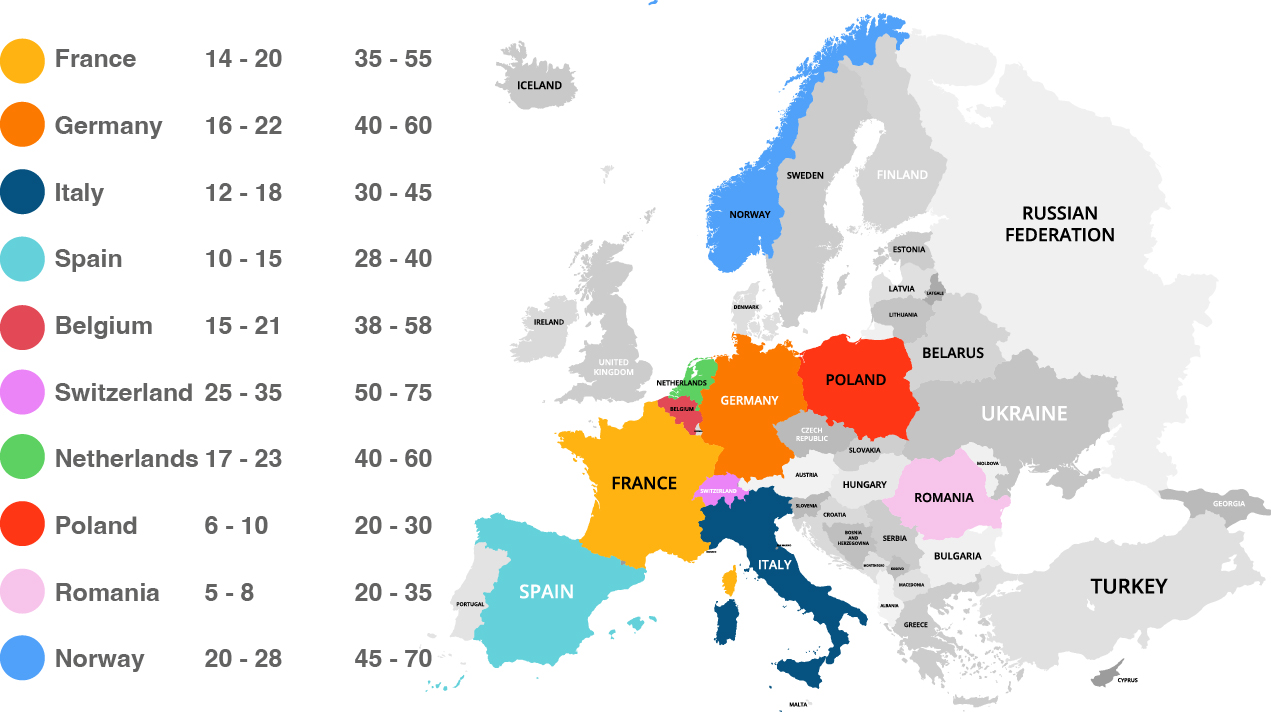
In Germany, salaried welders earn around €20/h with benefits, while in Norway freelance TIG welders can charge up to €70/h.
These examples show how income and opportunities vary by status.

This article compares both paths to help you make the right career decision in the welding industry.

Welder Job: Freelance or Company Employee

1. Welder Job as an Employee: Security and Stability

Advantages:

  • Job security: fixed income, paid holidays, health coverage, and social protections.
  • Continuous training and certification support.
  • Structured environment with equipment and supervision.
  • Certifications often funded by employers (€300–1000).

Disadvantages:

  • Limited income growth. Average hourly wages:
    • France: €14–20/h
    • Germany: €16–22/h
    • Italy: €12–18/h
    • Spain: €10–15/h
    • Poland: €6–10/h
    • Netherlands: €17–23/h
  • Less freedom: fixed hours and physical presence required.

2. Welder Job as a Freelancer: Freedom and Higher Income

Advantages:

  • Higher pay: €30–65/h depending on country:
    • France: €35–55/h
    • Italy: €30–50/h
    • Spain: €28–45/h
    • Belgium: €38–58/h
    • Germany: €40–60/h
  • Flexibility: choose your projects, clients, and hours.
  • Networking opportunities with each job.
  • Access to specialized sectors (aerospace, energy, etc.).

Disadvantages:

  • Income instability.
  • Administrative workload (clients, invoices, logistics).
  • Personal expenses:
    • Certifications: €300–1000
    • Insurance: €500–1500/year
    • Equipment and PPE

3. European Welder Job Comparison – Employee vs Freelancer

Employee (€/h)    vs    Freelancer (€/h)

Welder Job: Freelance or Company Employee

* These figures are estimates and vary based on experience, certification, sector, and region.

4. Certifications and the Welder Job Market

Certifications are essential whether you’re employed or freelance.

  • As an employee: Required for hiring and career growth. Companies often cover costs.
  • As a freelancer: Needed for access to large, high-paying projects in energy, aerospace, oil & gas, and more.

Key certifications:

  • ISO 9606-1: manual welding (TIG, MIG/MAG, electrode)
  • EN ISO 14732: automatic welding operators
  • ASME IX: heavy industry and international standards

5. Choosing the Right Path

Your welder job can be stable and secure or flexible and high-earning — depending on your goals. Full-time jobs offer benefits; freelancing offers freedom and higher pay but with more responsibility.

Many welders switch paths during their careers. What matters most is staying certified and professionally relevant.

Two Tools for Career Success:

  1. Certifications: Mandatory for most jobs and ensure compliance and employability.
  2. Hands-on training: Programs like those from ITAFORMA help you pass certification exams and connect with employers.

Bootcamp Itaforma: learn to weld in record time

Bootcamp Itaforma: learn to weld in record time

Learn to weld smarter not harder

The term bootcamp is no longer confined to the military. Today it refers to an intensive training method that focuses on the essentials: practice. We at ITAFORMA have rethought this concept to adapt it to a practical and sought-after profession: learning to weld.

Our goal? To offer an intense and extremely practical course designed for those who want to learn welding in a professional and serious way, whether for retraining, upgrading or seeking their first job.

Bootcamp Itaforma: learn to weld in record time

Learn to weld in an intense and practical welding way

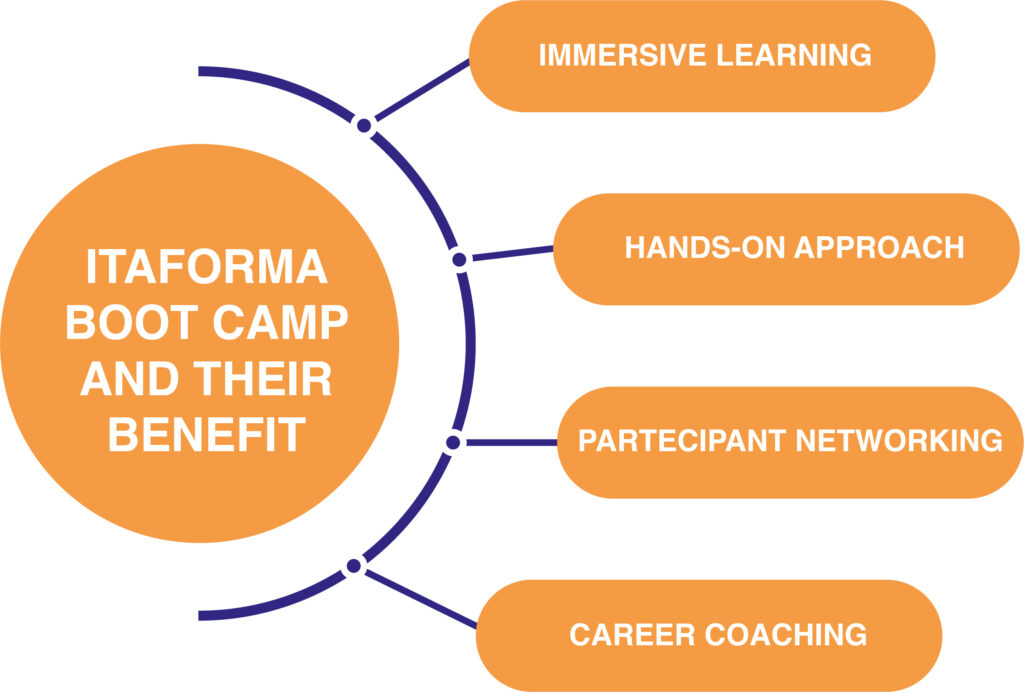
ITAFORMA bootcamps present a clear and effective structure: intensive courses focused on acquiring the skills essential to welding in a professional context.
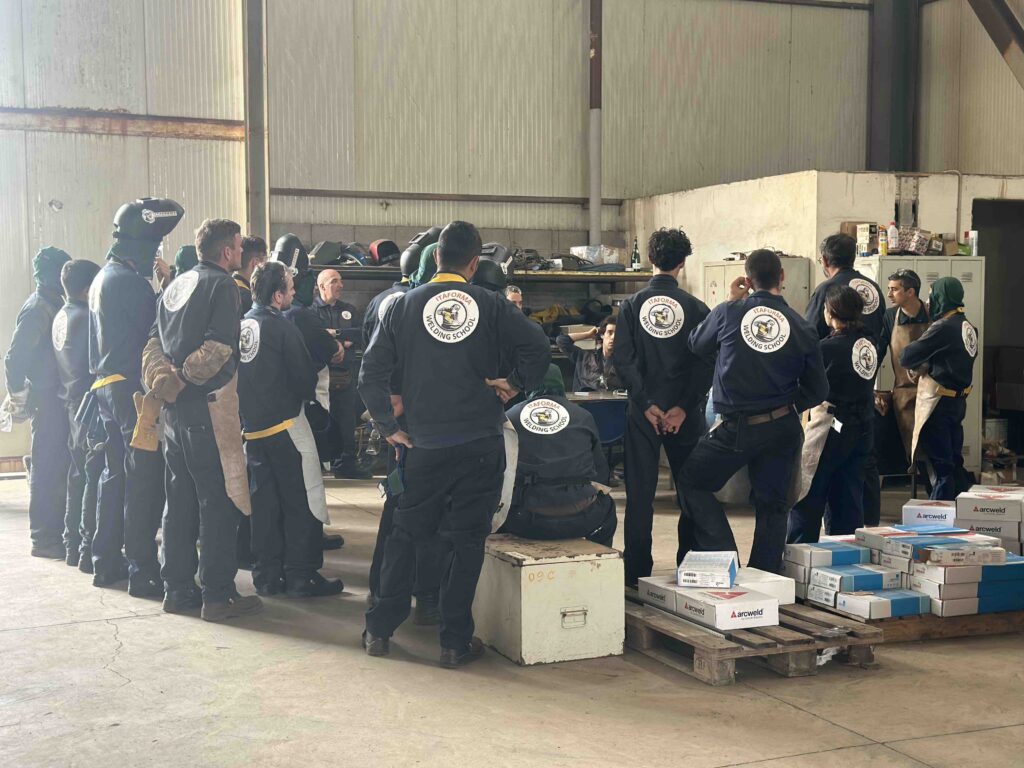
Learning takes place in real operating situations, both through practical activities in the field and in organizational work management, simulating a real work trip.
Each session is designed to teach welding under concrete conditions, combining focused theory and, most importantly, extensive hands-on experience.

Our workshops are fully equipped to allow students to practice safely from day one, within an industrial and professional environment.
Our instructors, true welding mentors and highly qualified professionals, regularly participate in international competitions and constantly update themselves on current regulations in Europe and abroad.

They are available to students every step of the way: from training on safety regulations, to using machines, to perfecting the technical gesture, to practical advice on the craft and building a career as a welder.

Learn to weld to find work quickly

Our bootcamps are designed to meet the specific needs of companies. The training takes place at a metallurgical production site, so you learn in a real-world/production setting. It is training done by professionals for professionals.
When you come to Itaforma to learn welding, you leave with real know-how, European certifications, and often a job opportunity within 1 to 3 weeks.

Learn to weld through a human and motivating experience

Learn to weld with ITAFORMA means much more than acquiring a technical skill: it is to live an intense and formative experience, immersed in a stimulating environment, surrounded by people who share the same goal of growth as you.
During bootcamp, you will become part of a true community of students, professionals and experienced instructors, ready to accompany you throughout your welding learning journey and beyond, offering ongoing support.

Students who choose to learn to weld with us come from all over the world. Beyond the technical experience, our bootcamp offers a unique human experience, fostering the building of authentic bonds with people of different cultures, ages and horizons.
Participating in the ITAFORMA BootCamp means not only learning to weld, but also training as professional welders, one of the most in-demand figures in international industry today.

Learn to weld by creating a solid professional network

Learn to weld with ITAFORMA also means joining a professional ecosystem designed to accompany you throughout your career.
Participating in an ITAFORMA bootcamp is not only an opportunity to acquire technical skills: it is a real opportunity to build a network of strategic contacts in the welding industry.

Joining ITAFORMA means access to a network of more than 2,000 partner companies and thousands of job opportunities aligned with your specialization and professional experience. Along the way, you will be able to participate in one-on-one interviews, practice tests under real-world conditions, and group recruitment sessions directly with our industry partners.

Learn to weld with us also means benefiting from the support of a network of former students, now established professionals, experienced mentors and specialized recruiters ready to facilitate your entry into the job market.
ITAFORMA encourages the creation of real synergies, offering not only technical training but also a powerful tool for building lasting relationships and launching a successful career.
Learning to weld is not just a matter of technique: it is learning how to navigate within a dynamic industry full of professional opportunities.

Bootcamp Itaforma: learn to weld in record time

A concrete investment in your future

Choosing to learn welding with ITAFORMA is a strategic investment in your future. Participating in a bootcamp means dedicating a short but intensive time to acquiring a trade that is in high demand in the job market.
Learning to weld and becoming a qualified welder guarantees a quick return on investment, providing access to numerous professional opportunities in Italy and abroad.

In the industrial world, welders are true professionals able to choose from the best contracts, the most competitive companies and the most advantageous working conditions. Learning to weld means acquiring valuable technical and manual know-how, applicable in sectors such as industry, construction, shipbuilding, automotive, refining, food, energy, pharmaceutical and many others.

Flexible, structured and person-friendly training

Our bootcamps, dedicated to those who wish to learn to weld efficiently, vary in duration from 2 weeks to 2 months, depending on the type of welding chosen and the

Training takes place entirely in-person, in our fully equipped laboratories: each trainee has his or her own workstation and welding machine. This approach allows us to offer a highly personalized course, in which each participant can learn to weld in complete immersion, followed individually by our experienced instructors.

At ITAFORMA, learn to weld means being the protagonist of your own learning, in an environment that values talent, commitment and personal growth.

Why learn welding with Itaforma?

  • To learn a concrete trade in just a few weeks and start a new career with a solid foundation.
  • To learn welding alongside experienced, nationally and internationally recognized professionals.
  • To progress quickly through intensive practice and learning in real work situations.
  • To be constantly supported, paired and mentored throughout your training.
  • To enter a booming industry sector, where the demand for qualified welders is ever increasing
  • To obtain official European welding certification, essential for working in the main markets of the sector.
  • To access numerous job opportunities and build a successful professional career in the welding world.

Would you like to learn welding for real?

Our bootcamps start every month.

Sign up now to learn to weld, certify skills and find a skilled job in just a few weeks.
itaforma.com

The Best Service for Finding Welding Jobs

ITAFORMA’s Welding Job Service

The welding profession offers numerous opportunities but also challenges, especially with the increasing demand for qualified welders.

ITAFORMA, a center of excellence for welding education, meets these needs with a powerful welding job service, free for both students and companies.

The school trains highly skilled welders and connects them with a network of over 1,700 partner companies eager to hire. In this article, we will explore how ITAFORMA supports its graduates throughout their careers by offering a lifelong service.

The Best Service for Finding Welding Jobs

1. ITAFORMA: A Welding School to Find a Welding Job

1.1 Quality Training to Ensure a Welding Job

ITAFORMA is a welding school renowned for the quality of its training. Each year, it trains hundreds of welders through a rigorous, hands-on curriculum.

The program is designed to meet labor market demands , allowing students to learn through real-world work situations. This approach helps them develop strong welding skills, giving them a significant advantage in the welding job market.

Upon completing their training, ITAFORMA students receive the European UNI EN ISO 9606-1 certification, an internationally recognized diploma that certifies their expertise. This certification guarantees quality and opens doors to professional opportunities both in Italy and abroad.

1.2 Practical Immersion for Success in Welding Jobs

One of the distinctive features of ITAFORMA is its practical approach to teaching. The school goes beyond theoretical lessons by immersing students in practical workshops, simulated construction sites, and real welding scenarios.

 This intensive “bootcamp” approach ensures they are trained to become junior welders who are well-prepared for the professional world by the end of their course.

ITAFORMA’s students are thus trained to be the best welders possible. This hands-on approach, combined with high-quality standards, makes them highly sought after by companies in the welding industry.

2. A Powerful Welding Job Service Thanks to a Network of Thousands of Partner Companies

2.1 Welding Jobs: A Network of Partners that Opens Opportunities

A key strength of ITAFORMA is its network of partner companies.
With over 1,800 companies in its network, the school has a robust support system to help graduates find welding jobs quickly after their training.

This ever-growing and dynamic network enables the school to connect students with potential employers in an efficient and timely manner.

ITAFORMA’s partner companies recognize the high-quality training provided by the school, knowing that its graduates are immediately operational. This minimizes their time and resources spent on training new employees, so companies are eager to recruit students, sometimes even before they finish their training.

2.2 Welding Jobs: Exceptional Employment Rate

The quality of training, coupled with such an extensive network, results in an exceptional employment rate for ITAFORMA graduates.

It is not uncommon for students to be “booked” by a company before completing their training. School statistics show that many students receive job offers even before obtaining their certification. This reflects the school’s appeal and the growing demand for qualified welders in the industry.

Companies know that investing in ITAFORMA’s training pays off significantly because students are prepared to work under pressure and meet the highest quality standards.

The Best Service for Finding Welding Jobs
 

3. A Lifetime Welding Job Service: Continuous Support for Graduates

3.1 Welding Jobs: Support Beyond Training

One of the most impressive aspects of ITAFORMA’s welding job service is that it continues long after graduation. The school offers support to its graduates throughout their careers. If a former student moves to another city, country, or even continent, they can always rely on ITAFORMA’s welding job service. The school will search for opportunities within its network of partner companies, but also explore other avenues to ensure a successful career transition. This proactive approach ensures ITAFORMA’s graduates always feel supported and reassured during their professional journey. Whether they’re seeking new opportunities with another company or considering relocating, they can count on the school’s continuous support.

3.2 Welding Jobs: A Strong and Loyal Community

ITAFORMA’s welding job service is further strengthened by a strong alumni community that supports each other. Manfredi, an ITAFORMA graduate, shares how he used the school’s job service three times throughout his career. He describes the school as a “family” that has supported him throughout his professional life. This reflects the strength of ITAFORMA’s network and the lasting impact of the support it offers to its alumni. ITAFORMA students are not only trained to become skilled welders but also join a solid professional network that supports them long after their initial training. This lifelong welding job service is a true advantage for their professional success.

ITAFORMA’s welding job service, Conclusion

ITAFORMA’s welding job service is a key benefit for anyone looking to start a welding career. The school offers much more than just technical training; it guarantees ongoing support for its graduates throughout their careers. With an expanding network of partner companies and high-quality practical training, ITAFORMA students enjoy exceptional employability, making it one of the best welding schools in Europe. The school’s commitment to its students and alumni is a true guarantee of success in a rapidly growing industry.

Manual Metal Arc Welding

Overview of Arc Welding with Covered Electrode

Arc welding with a covered electrode, also known as process 111, is one of the most widely used welding techniques in industry. It involves creating an electric arc between the electrode and the workpiece, generating intense heat (around 3200°C), which melts the metal in the pieces and the electrode.

The electrode, in addition to acting as the filler material, is coated with a flux that protects the weld from oxidation and influences the nature of the molten pool.

This process is valued for its simplicity, flexibility, and low equipment cost, while ensuring strong and durable welds.

Manual metal arc welding

How the Process Works and Welding Conditions

To ensure the proper functioning of the electric arc, several conditions must be met:

  • High voltage: required to create the electric arc.
  • Sufficient current: to maintain arc stability.
  • Ionizable medium: allowing current to flow between the electrodes.

Arc initiation (creating the electrical discharge between the electrode and the workpiece) must be done carefully, typically by lightly scraping the surface of the workpiece.

Improper intensity control or a rough contact between the electrodes can cause defects such as electrode sticking. Arc stability is crucial for achieving a high-quality weld and depends on several factors, including the quality of the welding machine, polarity, arc length, and the characteristics of the current (nature, frequency, intensity).

Depending on the intensity and diameter of the electrode, the welder must adjust the settings to ensure adequate penetration and avoid excessive spatter. For example, the relationship between weld bead size and electrode diameter varies depending on the type of joint (flat welding, inside corner welding, or outside corner welding).

Current Characteristics and Welding Equipment

The nature of the current plays a key role in arc welding with a covered electrode.
There are two main types of currents used in this process:

  • Direct current (DC), which creates a stable arc and allows the polarity of the electrode to be selected. Depending on the application, the welder can choose direct polarity (the electrode connected to the negative pole) or reverse polarity (the electrode connected to the positive pole).
  • Alternating current (AC), often used with flux-coated electrodes to improve weld stability, though it is generally less stable than direct current.

Welding equipment for covered electrode arc welding typically includes a current generator, an electrode holder, and a ground clamp. Depending on the work type and required intensity, transformer characteristics can vary, including open circuit voltage (U0), intensity adjustment range, and duty cycle.

Professional Applications and Advantages of Arc Welding

Arc welding with a covered electrode is widely used across various industries due to its versatility and ease of use. Key areas of application include:

  • Shipbuilding and boiler manufacturing, where weld strength is essential.
  • Civil engineering, for assembling heavy metal structures such as bridges and industrial buildings.
  • Oil and gas industry, where welds must withstand extreme conditions.
  • Maintenance and repair of infrastructure, including industrial equipment and machine repairs in mechanical workshops.
  • Repair of old metal structures, particularly when working on rusty or damaged parts.

Thanks to its ability to be used in outdoor environments (even in windy or humid conditions) and in confined spaces, this process is particularly suited to construction work.
Its ease of use, low equipment cost, and the durability of the welds make it the preferred choice in many industrial sectors.

Manual metal arc welding

The Importance of Practical Training to Become a Skilled Arc Welder

Arc welding is a technical skill that cannot be mastered through theory alone; practical training is essential to becoming a competent welder.

While understanding the basic principles of welding, types of currents, and materials is important, it is through repeated practice that a welder gains the dexterity needed to create strong and durable welds.

Precise manipulation of the electrode, controlling the arc length, and adapting to variable working conditions (such as different welding positions, weather, or material types) require hands-on experience.

A good welder must know how to adjust welding parameters (intensity, voltage, polarity) according to the specifications of the task at hand. Moreover, the ability to diagnose and solve common issues, such as electrode sticking, excessive spatter, or an uneven weld bead, relies on solid practical experience.

Specialized training centers and apprenticeship programs offer future welders opportunities to work on real projects and receive valuable feedback from experienced trainers.

Additionally, safety standards in welding are crucial and must be incorporated into the practice from the outset. Learning to manage risks associated with extreme heat, gas emissions, and flying metal shards is essential not only to ensure the quality of the work but also to safeguard the welder and their colleagues.

In summary, while theoretical knowledge is indispensable, it is practical experience that enables the welder to develop the technical skills, precision, and judgment necessary to succeed in this demanding profession.

At ITAFORMA, a Priest Becomes a Welder

How Faith and Welding Come Together

In Guinea, as in many African countries, access to vocational training remains a major challenge. Yet, in an ever-changing job market where skilled labor is increasingly in demand, learning a trade can be a life-changing opportunity for young people.

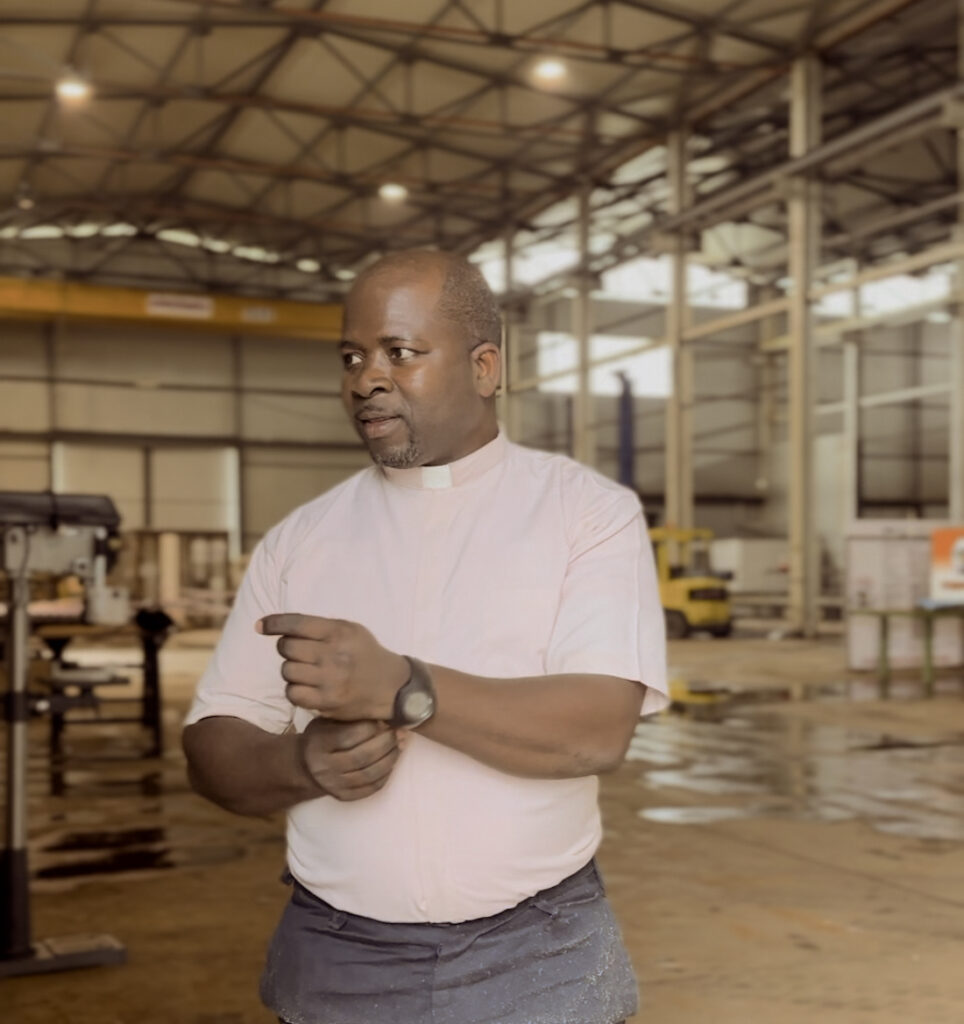
This is exactly the vision of Father Ignace, a Guinean priest who embarked on an unusual journey: traveling to Italy to train as a welder so that he can open a technical school in his diocese. His goal? To provide young people with a concrete alternative to migration by equipping them with professional skills that are highly sought after in the job market.

To make this dream a reality, he found invaluable support at ITAFORMA, a leading welding school in Italy that not only welcomed him with open arms but also provided him with a comprehensive and enriching training experience.

At ITAFORMA, Father Ignace is not just a student—he has become part of a community that shares his values and commitment to helping others.

Guinea: A Country in Search of Opportunities

Despite being rich in natural resources, Guinea struggles with economic and social challenges. The country is a major producer of bauxite, gold, and diamonds, but wealth distribution remains highly unequal. Youth unemployment is rampant, and many families live in poverty, with limited access to quality education.

While academic education is available, it often does not provide practical career opportunities. Young people frequently finish school without the technical skills needed to enter the workforce.

Adding to these struggles is the country’s political instability, with frequent coups and internal tensions. These factors push many young Guineans to leave their homeland, hoping to find a better future in Europe. Unfortunately, their journey is often full of risks: dangerous desert crossings, perilous sea voyages, and an uncertain future upon arrival.

This is why Father Ignace’s project is so crucial: providing local training opportunities can empower young people to build a stable life in their own country, reducing forced migration and contributing to the nation’s development.

The Church’s Role in Education and Social Support

For decades, the Catholic Church has played a key role in Guinea, helping communities through education, healthcare, and social projects. Many young Guineans rely on church-run schools and training centers to access quality education.

However, there is a significant gap: vocational training is still underdeveloped. While general education is widespread, many students lack hands-on skills that could help them find employment.

Father Ignace’s initiative aims to fill this gap, using the values of faith, commitment, and solidarity to guide his project. To him, teaching a trade is not just an economic necessity—it is a humanitarian and spiritual mission, giving young people the tools to shape their own future.

ITAFORMA - Corsi di Saldatura Metalmeccanica | Priest Becomes a Welder | Scuola ItaForma | Corso Saldatura

ITAFORMA: More Than a School, a True Ally

To achieve his vision, Father Ignace chose to train at ITAFORMA, one of Italy’s most respected welding schools. Here, he is mastering key techniques, including:

✅ Electrode, TIG, and MIG/MAG welding
✅ Torch and band saw cutting
✅ Using a grinder and drill

But ITAFORMA is more than just a training center—it is a place where students are truly supported. From the moment Father Ignace arrived, the school has gone above and beyond to help him develop his skills and knowledge, preparing him to launch his training center in Guinea.

The ITAFORMA instructors and staff have shown great generosity, recognizing the social impact of his mission. Whenever a helping hand is needed for a good cause, ITAFORMA is always ready to respond with enthusiasm.

Through solidarity and a commitment to education, ITAFORMA has become not only a training ground but also a source of inspiration for Father Ignace and his future school.

The Critical Need for Vocational Training in Africa

One of the biggest challenges in Africa remains the lack of vocational schools. While the demand for skilled workers is growing—especially in the construction and industrial sectors—young people have very few opportunities to acquire technical skills.

Many dream of learning a trade, but without access to proper training, they are left with no choice but to seek opportunities abroad. If more vocational schools were established, young Africans could find stable jobs in their own countries, contributing to local economic growth and development.

This is exactly the vision behind Father Ignace’s project: to create a welding school in his diocese inspired by ITAFORMA’s model, helping Guinean youth find meaningful employment and build a future at home.

ITAFORMA - Corsi di Saldatura Metalmeccanica | a Priest Becomes a Welder 3 | Scuola ItaForma | Corso Saldatura

Want to Learn Welding? ITAFORMA is the Right Place for You!

If you’re looking to develop in-demand skills and start a new career, ITAFORMA offers professional courses for all levels, from beginners to experienced welders.

📌 Sign up today:
👉 ITAFORMA – Welding Courses

With ITAFORMA’s support and expertise, and Father Ignace’s dedication to education, welding is becoming a powerful tool for change. 💪🔥

MIG/MAG Welding

1. Definition of the MIG/MAG Welding Process

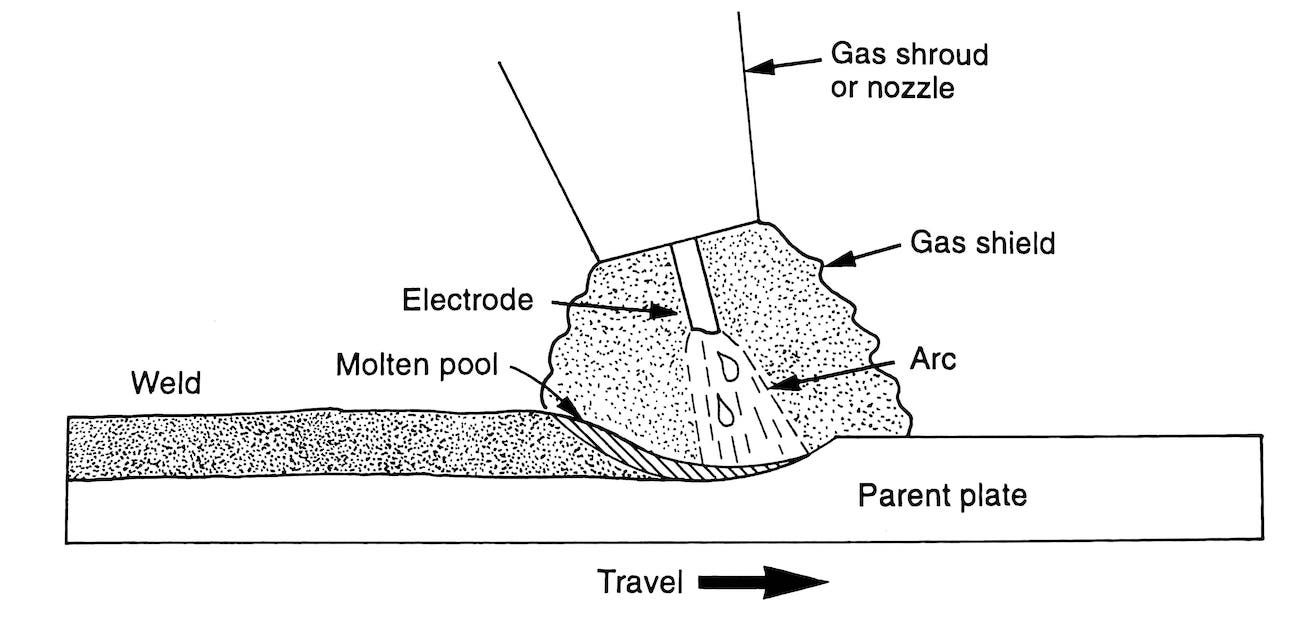
MIG/MAG welding (Metal Inert Gas/Metal Active Gas) is a widely used welding process in modern industry. This technique relies on creating an electric arc between a filler electrode wire and the workpiece. 

The arc generates enough heat to melt both the base metal and the electrode, forming a solid weld bead. The fusion occurs under the protection of a gas shield, either inert (argon, helium) for MIG welding or active (carbon dioxide, gas mixtures) for MAG welding. The gas shield prevents oxidation, ensuring the quality of the weld bead.

The main parameters influencing MIG/MAG welding include:

  • Wire feed speed (welding intensity)
  • Gas flow rate
  • Electrode wire diameter
  • Welding position (flat, vertical, etc.)
  • Preparation of the workpieces
  • Nature and thickness of the materials to be welded

2. Principle of MIG/MAG Welding

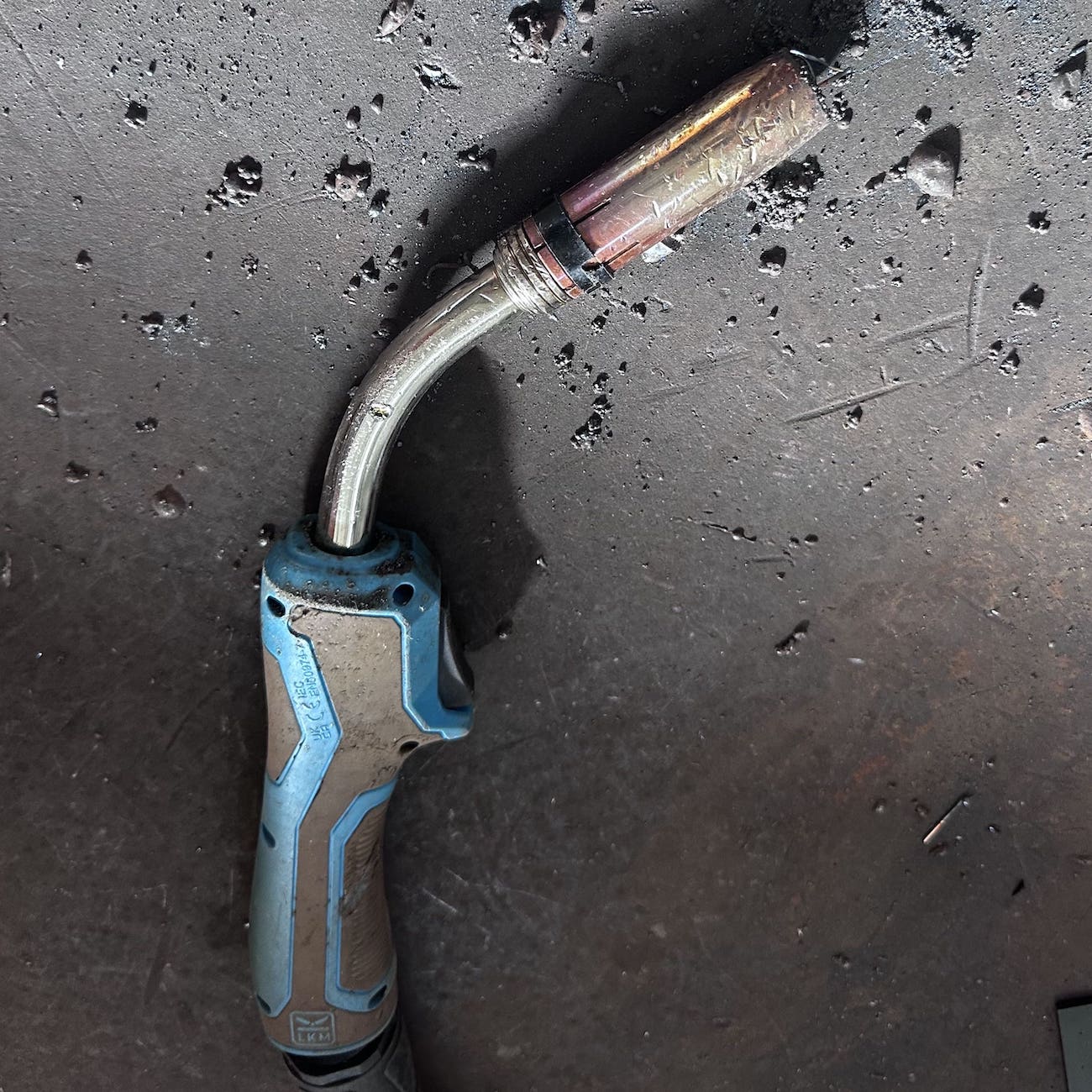
When the welder activates the trigger of the torch, it initiates the continuous feeding of the filler wire (hence the term “continuous wire welding”) while releasing the protective gas and closing the electrical circuit. The electric arc then forms between the electrode (wire) and the workpiece, generating sufficient heat to melt the materials. The filler metal, melted by the arc, combines with the base metal, creating a homogeneous weld. The process is performed under a gas shield that protects the molten area from oxidation, ensuring high-quality welds.

3. Advantages and Disadvantages of MIG/MAG Welding

Advantages:

  • Cost-effective: MIG/MAG welding is particularly economical due to its fast welding speed and low material costs.
  • High welding speed: This process allows for rapid welding, making it ideal for large-scale industrial production.
  • High metal deposition rate: The MIG/MAG process deposits a significant amount of filler metal, improving overall process efficiency.
  • Versatility in material thicknesses: MIG/MAG welding can be used for a wide range of material thicknesses.
  • Welding in all positions: This process can be used for welding in various positions, including overhead and vertical.
  • Aesthetic welds: The resulting weld bead is often of very high quality with minimal spatter, reducing the need for post-welding cleaning.
  • Automation potential: MIG/MAG welding is commonly used in robotic applications for repetitive, high-precision welding tasks.

Disadvantages:

  • Limited for thin materials: This process may not be ideal for very thin materials or delicate parts, as the heat generated can be too high.
  • Sensitivity to environmental conditions: In outdoor environments, the protective gas can be disturbed by wind, affecting weld quality.

4. Arc Transfers in MIG/MAG Welding

The different types of arc transfers impact the quality of MIG/MAG welds. These transfer types are determined by the adjustments of intensity and voltage.

  • Short Arc Transfer: In this mode, the arc periodically short circuits onto the workpiece, and the metal is deposited in small droplets. This mode is ideal for precise penetration welds, but the arc is unstable, leading to spatter.
  • Globular Transfer: This intermediate mode between short arc and spray transfer generates larger droplets with less penetration and more spatter.
  • Spray Arc Transfer: This mode creates stable fusion with fine droplets projected into the molten pool, providing deeper penetration and a higher deposition rate.

5. MIG/MAG Welding Unit Installation

Setting up a MIG/MAG welding station involves several key components:

  • Wire spool and feed system: The wire spool is the fundamental element for continuous filler wire feeding.
  • Feed system: The wire feeding is controlled by smooth or knurled rollers that regulate the wire speed.
  • Torch: The torch transports both the filler wire and the protective gas to the welding area.
  • Control unit: This unit allows for adjusting welding parameters such as wire speed, current intensity, and gas flow rate.

Ground clamp: Completes the electrical circuit necessary for the arc formation.

6. Industrial Applications of MIG/MAG Welding

MIG/MAG welding is used across a wide range of industries due to its flexibility and fast execution. Some of the most common applications include:

  • Automotive Industry: MIG/MAG welding is extensively used for assembling chassis, body parts, and repairing metallic elements made of aluminum or steel.

  • Metal Construction: This process is widely employed for welding heavy metal structures such as bridges, shipyards, industrial buildings, and pipeline installations.

  • Aerospace Industry: The precision of MIG/MAG welding is highly valued for assembling aircraft and spacecraft components.

  • Agricultural Equipment Manufacturing: MIG/MAG welding is used for manufacturing and repairing agricultural machinery, especially for steel structures.

  • Machine Manufacturing: Due to its ability to weld various metals, MIG/MAG welding is ideal for assembling parts in complex industrial machinery.

7. The Importance of Practical Training to Obtain MIG/MAG Certification ISO 9606-1

Becoming a skilled MIG/MAG welder requires quality hands-on training. While theoretical knowledge is important for understanding the basic principles of welding, practical skills gained in the field are essential for mastering MIG/MAG welding. This welding technique requires a strong grasp of torch handling, precise welding parameter adjustments, and weld quality control.

To obtain a recognized professional certification, such as UNI ISO 9606-1, it is crucial to undergo practical training at an accredited center. This certification ensures that the welder has the necessary skills to execute high-quality welds according to international standards. It is often required in demanding industries such as aerospace, automotive, and metal construction. 

Moreover, obtaining this certification increases the chances of securing a stable and well-paid job as a MIG/MAG welder, as it demonstrates a high level of technical competence and reliability—qualities highly sought after by employers.