Lavoro saldatore: freelance o dipendente in azienda?

Lavoro saldatore: freelance o dipendente in azienda?

Il mercato europeo della saldatura è in piena trasformazione: carenza di manodopera qualificata, rilocalizzazione industriale, crescita della domanda nei settori dell’energia, dei trasporti e della cantieristica navale.
In questo contesto dinamico, scegliere lo status giusto diventa una decisione strategica per chiunque cerchi un lavoro da saldatore stabile e ben retribuito.

Meglio puntare sulla sicurezza del lavoro dipendente o sulla libertà del lavoro freelance?

In Germania, un saldatore assunto nel settore automobilistico guadagna circa 20 €/h, con benefici sociali inclusi.
In Norvegia, un freelance certificato TIG può arrivare fino a 70 €/h in cantieri offshore. Questi esempi dimostrano quanto le opportunità e la retribuzione varino in base allo status.

Questo articolo propone un confronto completo tra le due strade professionali, per aiutare ogni saldatore a orientarsi verso il lavoro saldatore più adatto ai propri obiettivi.

Lavoro saldatore: freelance o dipendente in azienda

1. Lavoro saldatore come dipendente: sicurezza e stabilità

Vantaggi:

  • Stabilità lavorativa: reddito mensile fisso, ferie pagate, copertura sanitaria e previdenza sociale.
  • Formazione continua: le aziende spesso offrono corsi interni e coprono i costi delle certificazioni obbligatorie.
  • Ambiente strutturato: accesso a strumenti, strutture e supervisione tecnica.
  • Certificazioni finanziate: le aziende pagano le certificazioni necessarie, il cui costo varia da 300 € a 1000 € a seconda del procedimento e del paese.

Svantaggi:

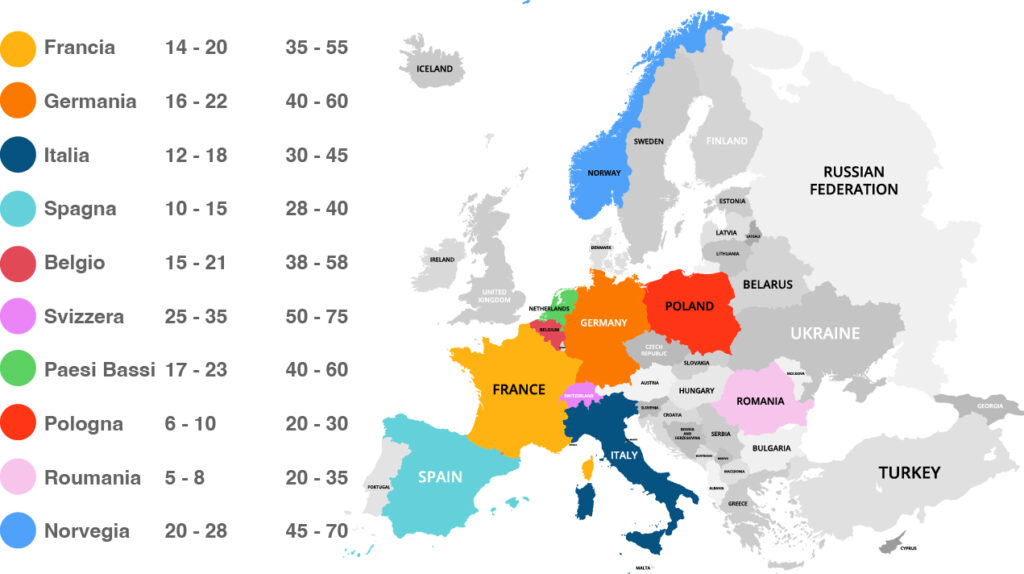
  • Reddito limitato: il lavoro saldatore da dipendente offre una retribuzione variabile secondo il paese. Secondo Eurostat (2023), la media oraria lorda è:
    • Francia: 14-20 €/h
    • Germania: 16-22 €/h
    • Italia: 12-18 €/h
    • Spagna: 10-15 €/h
    • Polonia: 6-10 €/h
    • Paesi Bassi: 17-23 €/h
  • Meno libertà: orari fissi e obblighi di presenza geografica.

2. Lavoro saldatore freelance: autonomia e redditi elevati

Vantaggi:

  • Retribuzione più alta: un lavoro saldatore come freelance consente di raggiungere tariffe orarie elevate. Ecco alcune medie:
    • Francia: 35-55 €/h
    • Italia: 30-50 €/h
    • Spagna: 28-45 €/h
    • Belgio: 38-58 €/h
    • Germania: 40-60 €/h
  • Libertà di scelta: possibilità di selezionare progetti, clienti e orari.
  • Rete professionale: ogni missione freelance permette di ampliare la propria rete di contatti.
  • Accesso a settori specializzati: alcuni settori (energia, aerospaziale, navale) cercano esclusivamente freelance certificati.

Svantaggi:

  • Instabilità: nessuna garanzia di reddito mensile.
  • Gestione autonoma: il freelance deve occuparsi di tutto: clienti, fatturazione, attrezzature.
  • Costi personali:
    • Certificazioni: autofinanziamento (300–1000 € per procedimento)
    • Assicurazione professionale: 500–1500 €/anno
    • Attrezzatura: saldatrici, DPI, manutenzione…

3. Confronto europeo tra lavoro saldatore dipendente e freelance

lavoro saldatore dipendente (€/h)    –    lavoro saldatore freelance (€/h)
Lavoro saldatore: freelance o dipendente in azienda

* I dati sono indicativi e variano in base a esperienza, certificazioni, settore e regione.

4. Certificazioni e lavoro saldatore: un legame diretto

Sia da dipendente che da freelance, la certificazione è essenziale per accedere a un lavoro saldatore qualificato.

  • Dipendente: la certificazione è spesso un requisito legale. In Europa, le norme di sicurezza e qualità richiedono saldatori certificati anche alla prima assunzione. Le certificazioni permettono anche avanzamenti e aumenti di stipendio.
  • Freelance: le certificazioni di alto livello (es. ASME IX) sono obbligatorie per accedere a cantieri rilevanti o missioni ben pagate, soprattutto nei settori energia, aerospazio, petrolchimico. Il saldatore freelance deve quindi considerare un budget annuale per aggiornare le sue qualifiche.

Certificazioni comuni:

5. Quale status scegliere per un lavoro saldatore di qualità?

Il lavoro saldatore cambia radicalmente in base allo status scelto, alle competenze e alle certificazioni.
Il lavoro dipendente offre sicurezza e benefici sociali.
Il freelance punta invece su autonomia, redditi più alti, ma con maggiore responsabilità.

Molti professionisti alternano i due status nel corso della carriera. L’importante è rimanere qualificati e competitivi.

Due leve fondamentali per ottenere un lavoro saldatore di qualità:

  1. Certificazioni ufficiali: richieste ovunque in Europa, permettono di lavorare legalmente e di accedere a progetti ben pagati.
  2. Formazione pratica e intensiva: corsi come quelli proposti da ITAFORMA preparano efficacemente agli esami, migliorano la tecnica e favoriscono l’inserimento nel mercato del lavoro grazie a una rete di aziende partner.
Welding Course: Your Path to an International Career in the Metalworking Industry

The ITAFORMA welding course is an exceptional opportunity for those seeking to acquire valuable technical skills, obtain international certification, and gain rapid access to employment opportunities.

Specialized training that will enable you to become an expert welder, meeting market demands.

Why Choose a Welding Course?

The role of a welder is currently one of the most in-demand in the industrial sector, spanning from metal construction to mechanics and even aeronautics. Companies seek qualified professionals capable of working precisely on various types of welds, such as steel, aluminum, cast iron, and more.

Advantages of taking a welding course:

– International Certification: A recognized certificate opens up global opportunities.

– Skill Versatility: You will learn various techniques, such as Electrode, TIG, and MIG/MAG welding processes on different materials.

– Rapid Entry into the Workforce: An individual welding course can help you find employment in just a few months.

– Access to a Well-Paid Job: A welder's salary can easily exceed the industry average.

What is learned in a welding course?

A comprehensive welding course includes a wide range of skills, suitable for both beginners and professionals.

1. Welding Fundamentals

– Understand the different types of welding processes: Electrode (SMAW), TIG (GTAW), MIG/MAG (GMAW), etc.

– Correctly use tools such as the welding machine or torch.

– Understand materials: steel, aluminum, stainless steel, etc.

2. Advanced Techniques

– Welding Processes: Master heterogeneous welding processes and those specific to delicate components.

– Correction of welding defects: analysis and repair of non-conforming welds.

3. Practical Application

– Simulate real working conditions through the “Welder's Cage” to prepare for work in companies and industrial plants.

Welding Course: An Investment for the Future

The cost of a welding course varies based on the modules chosen, but it is an investment that quickly pays for itself. Here are some guidelines:

– Basic Training and Certification

– Intermediate Training and Certification

– Advanced Training and Certification

Finding Employment After a Welding Course with ITAFORMA Services

After completing your welding course, the opportunities are numerous:

1. Become a Welder in an Industrial Company

Welding companies are constantly seeking talent for construction, repair, or innovation projects.

2. Work as a Freelance Welder

With a certification, you can work as an independent welder and offer your services to various clients.

3. Professional Advancement Towards Specialized Roles

With experience, you can become an inspector or trainer in the field of welding.

The Largest Welding Campus in Europe: Welcome to Itaforma

The Itaforma Welding Campus is your ideal destination; with its 16,000 sqm of workshops and production facilities, it represents the largest training center for welders in Europe, equipped with state-of-the-art equipment and a highly qualified staff.

Free Board and Lodging: A Unique Experience

For all those who choose to attend one of our intensive courses at the main Campus, we offer free board and lodging for the entire duration of the course. This arrangement not only eliminates all logistical concerns but also creates an ideal environment for complete focus on learning and professional growth.

A State-of-the-Art Campus

Our main facility is more than just a welding school: it is a true technological center equipped with over 100 welding machines and latest-generation machinery, including:

– Laser and Plasma Cutting

– Plate Rolling Machines

– Lathes

– Drilling Machines

– Guillotines and Shears

– Band saws

– Submerged arc welding machines

This equipment ensures our students have the opportunity to work with tools used daily in leading companies within the sector.

A 360° Training Experience

Taking the course at our main Campus is not just about learning a profession; it's a life experience.
Participants undergo a genuine “work travel simulation”, a unique opportunity to immerse themselves in the professional reality and best prepare to start a career immediately after the course.

This approach trains not only competent technicians but also professionals ready to face the daily challenges of working in a company or on assignment.

Welding Courses Across Italy

Itaforma offers welding courses in numerous Italian cities; however, many of our students choose to attend the main Campus to experience a comprehensive, unique training that prepares them to enter the job market with a significant advantage.

Choose the Itaforma Welding Campus

Join us and become part of the community at Europe's largest Welding Campus. Book your spot today and start your journey towards a secure and well-compensated professional career. With Itaforma, the future is in your hands!

How much does a welder earn?

What is a Welder's Salary?

A welder's salary varies based on several factors: whether they are a junior welder, an experienced welder, their years of experience, and if they hold a welding certificate.

The salary also varies based on the types and number of welding processes one is proficient in, the metalworking sector they operate within, whether they are a workshop welder or a traveling welder, if they are employed or self-employed, and also depends on the province, region, and country of employment, etc.

Thus, numerous variables influence a welder's net salary; indeed, the range between minimum and maximum pay can vary from €1400 to €5000 net per month.

Let's assume that welders are increasingly rare professionals in the job market and will become even more so in the future; consequently, salaries are set to rise significantly.

Why?

Welders are retiring without sufficient generational replacement, as young people are pursuing university degrees. Therefore, if companies require welders, they must offer competitive compensation to attract them.

Young people are often unaware that the welding profession is significantly better compensated than most office-based roles held by university graduates!
Indeed, a recent graduate today often starts with unpaid work, followed by internships earning 500-700€/month. After a year, this might increase to 1000€, then 1500€ after several years, eventually reaching a maximum of 2000-2200€ net after extensive experience.

In contrast, a Junior welder who has recently completed training at a reputable Welding School can immediately expect a minimum salary of 1400-1600€, plus overtime.
Within the first year, net earnings typically reach 1800-2000€, with potential for salaries to double or triple based on proficiency and experience, as outlined previously.

The future will see a continuous increase in the use of iron-based systems, constructions, and products. Consequently, welding and the role of a welder will become increasingly essential and difficult for companies to source.

As is well known, scarcity significantly drives up market value!

Concerning our nation, Italy ranks as the second most significant country in Europe within the metalworking sector, following Germany. Thousands of companies are actively seeking welders to join their workforce daily but are struggling to find qualified candidates. This is evident from the numerous job postings for welders found online, at employment centers, and through recruitment agencies.

Today, securing employment as a welder is remarkably straightforward for certified professionals!

What Factors Influence a Welder's Salary?

1) Working in Northern Italy typically commands higher remuneration due to a greater concentration of companies and a scarcity of available welders.

2) On average, a welder with a couple of years of experience proficient in one welding process earns between 1800€ and 2200€. Proficiency in two welding processes can increase earnings up to 2500€, while expertise in three welding processes can lead to 3000-3500€.

3) Willingness to undertake work-related travel can result in offers of up to 5000€ net per month.

4) Welders specializing in structural steelwork typically earn less than those working on plant engineering. Consequently, higher compensation is associated with welding more valuable components and working with premium materials (e.g., Aluminum, Stainless Steel, P11, P22, Titanium, etc.).

Naturally, all the aforementioned conclusions are subject to individual variation, differing from welder to welder and company to company. However, they represent a realistic and tangible national average for the sector.

Upon completion of their training, our course participants typically secure employment as Junior welders, earning an average net salary of 1400€ to 2000€ per month.

After one year, they begin to command higher salaries, eventually reaching the remuneration levels of professional welders. Many of our course participants, in addition to gaining field experience, frequently return to our School during their holidays to further their training, enhancing their resumes with additional welding processes or by learning to weld high-value materials.

Are you ready to embark on a rewarding career as a Welder?

Explore all our courses; click here!

Through the ITAFORMA School, finding employment is easy.

96% of ITAFORMA Metalworking School students typically find employment within one month of completing our Professional Courses for Welders, Pipefitters, and Structural Steel Fabricators.

ITAFORMA boasts an exceptionally high employment rate!

Only a very few vocational schools across all sectors and universities in Italy achieve such a high immediate placement rate for their students.

Why do ITAFORMA students find employment so easily and quickly compared to many others?

This is attributable to several crucial factors that should not be underestimated:

1) Upon completing ITAFORMA training, students are among the best Junior Metalworkers available on the job market, making them highly sought after by metalworking companies.
Why do they become among the best Junior Metalworkers in Italy?
It's simple! They undertake the longest, most rigorous, and most intensive metalworking course available; this makes them exceptionally well-prepared and, consequently, highly sought after by companies seeking welders, structural steel fabricators, pipefitters, assemblers, and metalworkers in general.

2) Upon completing their metalworking training, students have access to crucial and unique Employment Support Services provided by ITAFORMA School.

That's right, ITAFORMA School has an internal office that acts as an intermediary between its students and industry companies, much like a Specialized Employment Agency.

The service is completely free of charge and connects ITAFORMA students seeking employment with metalworking companies looking for workers.

3) ITAFORMA School has established an extensive Metalworking Network, forming direct collaborations with over 800 Italian and international companies who contact us daily to book and reserve our students.

During the training period, having understood each student's requests and specific aptitudes, we connect each of them with various companies to arrange interviews, practical assessments, or job offers consistently aimed at employment.

What are ITAFORMA School's employment support services?

They are numerous and represent the strength and secret to the success of the School, its students, and ITAFORMA's partner companies.

▸ For our students, we prepare a Metalworker's CV in both Italian and English,

▸ We create Video Resumes for each student during practical training, to be sent to company production managers,

▸ We provide a contact list of at least 50 Companies actively seeking welders,

▸ We put them in direct contact with company managers,

▸ We arrange interviews and practical work assessments.

These are ONLY some of the Employment Services we provide, enabling our students to receive concrete job offers from across Italy.

And it doesn't end there... there's another percentage that concerns us and which we consider very important!

In fact, in the last year, ALL of our students (100%) who completed one of our Electrode Welder – TIG Welder – MIG/MAG Welder – Pipefitter – Metal Fabricator courses, and who had their own transportation and were willing to relocate if necessary, received at least 2 job offers from our partner companies.

We are proud of our work and strive to improve continuously, day after day, by meeting the needs of Students and Companies, constantly updating our training programs with cutting-edge technology and innovative work techniques most sought after by companies.

Answering the initial question: is it easy to find a job through ITAFORMA school? The answer is “absolutely YES!”

The job search, practical assessment, and start of employment for each of our students are very simple, fast, and immediate! See for yourself!

Learn more about our training courses for Welders – Industrial Pipefitters – Metal Fabricators – Mechanical Technical Drawing

Read our students' testimonials!

Watch ITAFORMA School's Videos